By Kirsten Kern, Head of Financial Services Regulatory and Bright Tibane, Partner, Bowmans
On 6 February 2026, the Financial Sector Conduct Authority (FSCA) issued FSCA Communication 1 of 2026 announcing that a draft determination relating to foreign collective investment schemes (CISs) has been submitted to Parliament (draft Determination). The draft Determination follows the FSCA’s request for (and consideration of) written submissions from the public which were due on or before 11 October 2024.
The draft Determination sets out the requirements and conditions for foreign CISs soliciting investments in South Africa under the Collective Investment Schemes Control Act, 2002 (CISCA). It is intended to replace and repeal Board Notice 257 of 2013 (BN 257), which has governed these requirements and conditions since 13 December 2013.
The draft Determination was created because:
BN 257 has become outdated due to the shift from a predominantly rules-based to a principles-based regulatory approach; and
the Financial Services Tribunal’s (FST) decision in Greenman Investments S.C.A., Sicav‑Fis v FSCA Case No.: A2/2021 meant that a review of BN 257 was required. In this decision, the FST held that the FSCA has the discretion to categorise foreign CISs for the purposes of applying legislation that is not pre-stated as being applicable to foreign CISs, but such discretion is limited to a specific purpose (ie to apply the provisions of CISCA).
The draft Determination retains the format of application for approval of a foreign CIS under section 65(1) of CISCA as contemplated under BN 257. However, it proposes to expand the conditions for approval under section 65(1) of CISCA. At a high-level, the draft Determination states that a foreign CIS applying for approval in terms of section 65(1) of CISCA will be required to satisfy the FSCA on an ongoing basis that, amongst others:
The manager of a foreign CIS will organise and control the foreign CIS in a responsible manner.
The foreign CIS does not lend or advance any money, except that the foreign CIS may lend or offer to lend assets included in the foreign CIS in the manner, within the limits or on the conditions determined in the founding document or the instruments of incorporation or the prospectus.
The investments that a foreign CIS proposes to offer for sale in South Africa have a risk profile that is not significantly higher when compared to the risk profile of similar investments in participatory interests offered for sale in South Africa by managers registered under CISCA.
The solicitation of investments in the foreign CIS will not be contrary to the interests of investors, potential investors, the financial sector or the public interest. The FSCA will consider and apply this criterion based on the facts of each matter, its regulatory and supervisory insights and principles of fairness. The FSCA will, in due course, consider whether it is necessary to issue further guidance that informs the public interest criteria but it is not possible at this stage to confirm that such guidance will indeed be issued.
The structure of the foreign CIS is one which is allowable in South Africa under CISCA.
The liquidity of the securities of the foreign CIS will not compromise the liquidity terms of the foreign CIS.
The draft Determination also proposes to impose the following conditions on foreign CISs:
The manager of a foreign CIS may not, prior to approval in terms of section 65 of CISCA, include in or have part of the name of its business or in any description of its business any reference to a scheme approved under section 65 of CISCA without the approval of the FSCA.
Prior to approval in terms of section 65 of CISCA, a foreign CIS or its manager may not perform any act to lead the public to believe that it has been approved to solicit investments in the foreign CIS from the members of the public in South Africa.
A foreign CIS may not utilise any of the following investment strategies or approaches, or invest in the following assets or instruments in respect of and on behalf of its foreign scheme: (i) uncovered short selling; or (ii) a synthetic portfolio or synthetic exchange-traded fund that creates synthetic exposure for an investor, excluding where such portfolio or fund is only promoted to any investor that is not a ’qualified investor’ as defined in Board Notice 52 of 2015 (Determination on the Requirements for Hedge Funds).
In the FSCA’s view, the draft Determination is representative of a process of updating the existing BN 257 to better reflect international best practice and the supervisory experiences pertaining to applications by foreign CISs since its publication in December 2013.
In terms of the draft Determination, an application for approval in terms of section 65 of CISCA submitted to the FSCA before the commencement of the draft Determination but which has not been finally determined will be considered by the FSCA based on BN 257.
It is expected that the draft Determination, once implemented, will result in a stronger and more appropriate regulatory framework governing the advertisement and solicitation of foreign CISs in South Africa, thereby resulting in better protection for investors/customers.
The FSCA envisages that the cost implication, if any, of the draft Determination will not be significant as it is largely based on existing requirements contained in BN 257 and the associated guidance notices. The draft Determination is proposed to come into effect on the date of publication once it has been finalised.
For ease of reference, a copy of the draft Determination and the related supporting documents can be accessed here.
By Caper van Heerden and Jan Kruger, Partners, and Alison Mellon, Knowledge Lawyer, Banking and Finance, Bowmans
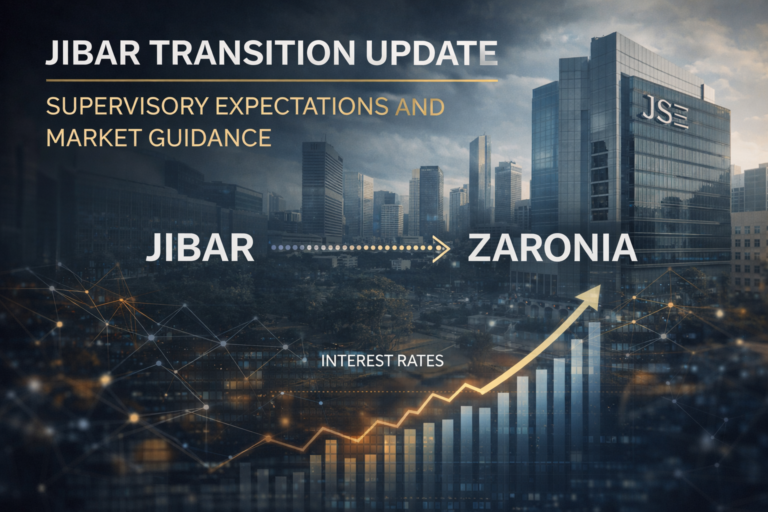
The Market Practitioners Group (MPG), established by the South African Reserve Bank (SARB) to oversee the transition from JIBAR to the South African Overnight Index Average (ZARONIA), has published updated guidance recommending that 1 May 2026 be adopted as the effective date for the ‘No new JIBAR’ milestone (instead of the initially proposed end of March 2026).
Importantly, the MPG has recommended that the SARB issue a formal regulatory directive to give effect to this milestone, confirming the full scope of JIBAR tenors prohibited for new use, setting an unambiguous effective date and defining what constitutes ‘new’ use consistent with offshore regulatory practice.
Once the directive is issued, market participants would no longer be permitted to enter into new financial contracts referencing JIBAR (including loans, floating rate notes and money market instruments) except in limited, narrowly defined circumstances. JIBAR itself will cease to be published at the end of December 2026.
The MPG has recommended a broad definition of ‘new’: it captures renewals, refinancings, rollovers, reopenings, re-issuances and material amendments that create additional JIBAR risk. The MPG has also recommended limited dispensations and exceptions to address specific risk management and operational needs. These include:
Defined exceptions for existing JIBAR exposures: examples given were market-making to support client activity related to pre-milestone transactions and associated hedges, hedging or reducing pre-milestone JIBAR exposure, novation and resets of pre-milestone JIBAR trades, central clearing counterparty (CCP) auction participation and associated hedges, physical delivery of options (including swaptions) executed before the milestone, and JIBAR-linked cash market instruments with robust, hardwired contractual fallback language.
Trade finance: trade finance transactions that require a known interest rate at the start of the interest period, including working capital loans, supply chain finance and invoice discounting, letter of credit discounting and financing, receivables discounting, trade loans between banks and fixed-term working capital loans.
Retail and property finance: a regulatory dispensation for JIBAR-linked retail home loans, related funding transactions and commercial property finance in securitisation; these may continue to reference JIBAR until cessation.
Securitisations: JIBAR-linked securitisations that meet certain criteria. For example, where the underlying assets rely on a forward-looking term rate, where active transition would be onerous or costly, or where transitioning to ZARONIA compounded in arrears would weaken the credit structure due to structural impediments or basis risk.
Offshore-aligned exceptions: use of defined exceptions aligned to offshore best practices.
The legislative safety net
The SARB is working on amendments to the Financial Sector Regulation Act 9 of 2017 to designate replacement benchmarks for legacy contracts without adequate fallback provisions, including statutory safe harbours from liability. However, institutions should not view this as a ‘silver bullet’ — different replacement rates may be designated for different product classes, and proactive transition planning remains essential.
The full MPG publications and recommendations are available on the SARB MPG webpage.
Click here to read the joint Prudential Authority and FSCA communication outlining supervisory expectations for the transition from JIBAR to ZARONIA and the “No new JIBAR” initiative.
SAIFM would like to share the below Joint Communication issued by the Prudential Authority and the Financial Sector Conduct Authority regarding the transition from JIBAR to ZARONIA and the supervisory expectations relating to the “No new JIBAR initiative”.
This communication provides important guidance to financial institutions as the market prepares for the cessation of JIBAR and the move towards alternative reference rates.
The Financial Sector Laws Amendment Act, which was passed in 2021, inserted a new chapter in the Financial Sector Regulation Act, 2017 (FSRA). It established a new framework to repeal the system of curatorship for distressed banks and replace it with a process of resolution for banks (Resolution Framework). The Resolution Framework was largely based on similar laws passed in other G20 jurisdictions, but with a critical difference that concerned the securities lending industry.
It is a known feature of international bank resolution that a when a bank goes into resolution, various types of contracts, including master agreements like the GMSLA, cannot be terminated and close-out netted merely because of the fact of resolution. (They can, however, be terminated and close-out if another ‘event of default’, such as non-payment, occurs.) However, while other types of contracts can ultimately be cancelled or bailed in (ie the amount payable by the bank in resolution reduced or zeroed) in international bank resolution, the long-standing position has been that most derivatives, securities lending and repo transactions cannot be cancelled or bailed in (or, in some instances, they can be cancelled or bailed in after close-out netting).
South Africa’s Resolution Framework, in contrast, protected derivatives but not securities lending and repo transactions, from cancellation or bail-in. The result of the introduction of bank resolution without protection for securities lending and repo transactions was the potential for South Africa to lose its clean netting status in respect of the GMSLA and GMRA because, on resolution of a bank, the GMSLA and GMRA could be cancelled or bailed before the other party had any opportunity to close-out and net outstanding transactions.
After significant industry lobbying by the South African Securities Lending Association (SASLA) and others, in early 2023, the South African Reserve Bank (SARB) heard securities lending industry participants and committed to amending the Resolution Framework to give securities lending and repo transactions the same protection from cancellation and bail-in that was already afforded to derivatives.
Although it was then too late to change the FSLAA or FSRA, the SARB issued the Interpretation Ruling Relating to Resolution Action on the same day that the Resolution Framework came into effect – 1 June 2023 (Interpretation Ruling). The Interpretation Ruling simply stated that, in interpreting its own powers as resolution authority under the Resolution Framework, the SARB did not consider that securities lending and repo transactions could be cancelled or bailed in. The SARB also pledged to amend the relevant section of the FSRA through an amendment (FSRA 166S Amendment) in the long-awaited Conduct of Financial Institutions Bill (CoFI). The FSRA 166S Amendment was approved by SASLA members and other industry participants.
It ultimately became clear that CoFI would take longer to pass than originally anticipated. Therefore, in December 2024 the FSRA 166S Amendment was proposed in the General Laws (Anti-Money Laundering and Combating Terrorism Financing) Amendment Bill 2024 (Amendment Bill). Following a consultation period, the second draft of the Amendment Bill was published at the end of 2025 containing the same proposed FSRA 166S Amendment. Market participants were given until 13 February 2026 to comment on the Amendment Bill. The FSRA 166S Amendment has not been changed from the original proposal for inclusion in CoFI.
The following four documents have been published by the Market Practitioners Group (MPG) and are now available on the South African Reserve Bank website.
These publications relate to Jibar transition planning and coordination, as well as developments in the cash market workstream:
Transition Planning and Coordination
‘No new Jibar’ Recommendations – Proposed framework for a market-wide milestone from 1 May 2026 to prevent the creation of new Jibar exposures ahead of cessation.
Transition Approach Recommendations – Guidance on active, passive and legislative pathways for transitioning legacy Jibar exposures across key product markets.
Cash Market Workstream
Recommendations for a ZARONIA Transition in the Retail Market – Analysis of the impact of Jibar cessation on retail mortgage markets with recommendations to support an orderly transition.
Important Changes to Your Jibar-Linked Loan – A consumer-focused guide explaining the cessation of Jibar and how affected retail loan agreements may transition to alternative reference rates.
The 10th Annual SAIFM Regulatory Summit (www.regulatorysummit.co.za) takes place on 20 August 2026 in Sandton, with both in-person and virtual attendance options available. Focused on education, this year’s event will explore the critical relationship between education and regulation in a rapidly evolving financial landscape.
With the continuous development of financial products and regulatory frameworks, it remains essential for financial market professionals to stay ahead by maintaining current, practical knowledge. The Summit will facilitate meaningful discussions on how regulation can help identify and bridge knowledge gaps, and how the industry itself can proactively remain future-ready.
We are pleased to announce Maya Fisher-French — Founder, Maya on Money | Award-Winning Financial Journalist & Consumer Advocate as the Keynote Speaker for the event.
“This event is a MUST for anyone involved in providing or advising on financial services. The insights shared by the speakers and participants are invaluable.” – Natalie Scott, Director · Werksmans Attorneys
Building on its 2025 Work Program, IOSCO will keep its focus on strengthening capital markets. IOSCO’s key strategic priorities for 2026 are: (i) Strengthening Financial Resilience and Market Effectiveness, (ii) Protecting investors, (iii) The evolution of Public and Private Markets; (iv) Technological transformation, and (v) Promoting regulatory cooperation and effectiveness.
While the work programme showcases IOSCO’s initiatives, IOSCO remains committed to close collaboration with other international organizations and standard setters such as the International Monetary Fund (IMF), the Organisation for Economic Co-operation and Development (OECD), the World Bank and the Financial Stability Board (FSB) to address emerging risks and shared global challenges, promote greater alignment in regulatory approaches, and support initiatives related to capital markets development.
Overview of IOSCO’s 2026 Work Program
1. Strengthening Financial Resilience and Market Effectiveness
Ensuring the resilience of the global financial system remains a key pillar of IOSCO’s mandate. IOSCO will finalize several ongoing work streams, including:
New key initiatives in this field for 2026 include:
Seeking to address issues related to over-the-counter (OTC) derivatives reporting fragmentation.
Work on the impact of market microstructures on liquidity and of extended trading hours on equity trading venues.
Contributing to FSB’s work on issues of non-bank data availability, use and quality.
Contributing, as necessary, to follow-up work on the issue of leverage in non-bank financial intermediation (NBFI).
IOSCO will continue to develop work to strengthen the operational resilience of Financial Market Infrastructures (FMIs) through the Committee on Payments and Market Infrastructures (CPMI)-IOSCO Operational Resilience Group. This work both considers whether there are gaps in the effectiveness of FMIs’ management of third-party risks and how to address potential gaps in FMI’s cyber resilience.
2. Protecting Investors
IOSCO will further strengthen its efforts in investor education by launching its first TechSprint, in partnership with the UK Financial Conduct Authority’s AI Lab. This initiative aims to leverage technology to develop educational resources that empower retail investors to navigate the novel products available to them, understand the risks and opportunities associated, and identify scams.
IOSCO will also explore these novel products, such as crypto-asset funds, private credit vehicles and retail-facing derivatives, which offer greater choice to investors but may also introduce new risks.
IOSCO will continue to engage with platform providers such as social media companies, search engines and internet providers to advocate for the restriction and monitoring of harmful or fraudulent content, and to promote the use of I-SCAN – its Enhanced Investor Alerts Portal. This new system offers a global real-time database of supervisory alerts on unauthorised firms and known scams to improve the protection of clients and investors and fight financial fraud.
3. The Evolution of Public and Private Markets
Capital markets are evolving, with a significant decline in public debt and equity issuance, and a rise in trading fragmentation and growth in private markets, introducing new complexities.
Key initiatives in this field include:
An exploration of the growing interconnectedness between private equity activities and the audit sector.
Contribution to the FSB’s deep dive on private credit.
Research work on the functioning of public markets.
4. Technological transformation
The adoption of Artificial Intelligence (AI), the intersection of digital assets with traditional finance and the rise of tokenization all present significant opportunities for financial markets and their investors but they can also present risks.
In 2026, IOSCO will advance its crypto-asset roadmap by finalizing a formal methodology for crypto and digital assets assessments, initiate regular thematic reviews, and continue to monitor developments arising from financial technology adoption.
IOSCO will also develop a supervisory tool kit on AI and guidance for firms on disclosures and governance in relation to AI and will focus on Supervisory Technology (SupTech), after the recent creation of a dedicated collaborative forum for members to share knowledge on how technology and in particular AI-powered tools can boost the efficiency of supervision and enforcement.
5. Promoting Regulatory Cooperation and Effectiveness
Promoting regulatory cooperation and effectiveness remains a key strategic priority of IOSCO. A key priority will be to assist members from emerging markets to build sound and robust capital markets, through enhanced capacity building, strengthened partnerships with international financial institutions, and direct assistance in addressing identified challenges.
Regulatory cooperation remains central to the effective delivery of these priorities. In particular, the IOSCO Multilateral Memorandum of Understanding (MMoU), with 131 signatories, is the global gold standard for international enforcement cooperation for financial markets.
IOSCO will continue to support MMoU signatories, including by encouraging them to upgrade to the Enhanced MMoU (EMMoU) and by conducting training and reviews. IOSCO will also continue to support non-signatories in meeting the requirements for adoption, ensuring that the global safety net against misconduct remains tight.
IOSCO will continue its regular reviews, promoting the consistent application of securities regulation worldwide.
IOSCO will also continue to deliver tailored capacity-building initiatives as part of the NEXTGEN program. In that context, a new dedicated e-learning platform will be developed during 2026 to expand the reach and value of this key part of IOSCO’s mission.
Public discussion about creditworthiness in South Africa often assumes a single assessment: the borrower is either suitable for credit or they are not. In the South African regulatory terms, the creditworthiness rests on two distinct assessments with different purposes, beneficiaries and legal consequences: credit risk assessment and affordability assessment. Although these assessments may share certain elements and may increasingly be performed at the same time through automated decisioning, they are not interchangeable. The distinction matters for law, supervision, remedies and policy as lending becomes more digital and data driven.
Two assessments, two purposes
Credit risk assessment and affordability assessment answer different questions and serve different regulatory objectives.
Credit risk assessment assesses whether the lender is likely to be repaid. It is prudential in nature and protects lenders and the financial system from losses. In the banking sector, credit risk is integrated into capital and solvency requirements through frameworks influenced by Basel, which translate Probability of Default, Loss Given Default and Exposure at Default into risk-weighted assets for capital adequacy.
Affordability assessment assesses whether the consumer can repay credit instalments without becoming over-indebted. It is a conduct and consumer protection requirement under the National Credit Act (sections 81 and 82 read together with Regulation 23A). Affordability assessment protects consumer welfare and dignity and provides the basis for remedies such as debt review and reckless lending findings.
The two assessments differ not only in purpose, but also in beneficiary. Credit risk assessment protects lenders and the financial system; affordability assessment protects consumers. A borrower may therefore be a good credit risk and still be legally unsuitable for credit on affordability grounds. This duality is a foundational feature of South African credit regulation.
Prudential and Conduct regulation in South Africa
South Africa’s Twin Peaks model reinforces the institutional distinction between the two assessments. The Prudential Authority supervises solvency, capital adequacy and risk management in banks, insurers and designated financial conglomerates. Non-bank credit providers, including retailers, micro-lenders and digital lenders, are not prudentially regulated on a standalone basis, even though they form part of the financial services sector. (Certain non-bank credit providers may be prudentially captured at the group level where they form part of a banking or insurance conglomerate). The National Credit Regulator supervises the credit market under the National Credit Act, while the Financial Sector Conduct Authority supervises market conduct, consumer protection and fairness. This configuration makes the legal separation between credit risk and affordability visible in supervisory mandates.
Within the Twin Peaks model, combined automated credit risk and affordability assessments create supervisory challenges. A singular credit decision may implicate prudential considerations (credit risk) and conduct considerations (affordability), but the outcome does not indicate which assessment failed. Without clarity, it becomes difficult for supervisors to understand market behaviour or emerging risks.
Data, modelling and behavioural credit risk
Credit risk assessment and affordability assessment differ in their relationship to data variables and prediction. Affordability assessment is grounded in verified financial facts: income, living expenses, existing debt obligations and disposable income. These inputs speak to current capacity.
Credit risk relies increasingly on behavioural and predictive variables. Traditional credit bureau data remains central, but digital credit models incorporate additional variables such as employment category, transactional data and consumption patterns. Machine-learning methods allow these variables to be aggregated to estimate default probability and support risk-based pricing. These models are commercially efficient and improve financial inclusion for consumers with limited credit histories, but they also raise explainability and fairness concerns because many inputs function as socio-economic indicators. For example, a credit risk model may use data such as geolocation or employment type, which can indirectly lead to bias. Affordability does not raise equivalent concerns because it is based on direct financial verification. When credit risk and affordability assessments are combined into a single automated decision, it becomes difficult to determine whether a decline was based on affordability or influenced by indirect biases in credit risk modelling.
Some behavioural or transactional variables may overlap with affordability inputs. For example, transactional data may help verify income or expenditure patterns. However, overlap does not eliminate conceptual distinction. Predictive variables improve estimation of default probability; affordability requires evidence of financial capacity. One assessment is probability-based; the other is factual.
The distinction is material: affordability assessment is statutory and evidence-based and credit risk is predictive and model-based. The two assessments may use overlapping information, but they process it for different purposes and under different regulatory frameworks. For example, the National Credit Act requires that debt repayment history be assessed through a consumer credit information file obtained from a credit bureau. Credit bureau data can therefore support both assessments, but in different ways. For credit risk, credit scores, behavioural variables and repayment patterns inform probability of default modelling. For affordability, credit bureau data identifies existing obligations and past repayment behaviour for the purpose of verifying a consumer’s financial means, prospects and obligations.
Within a credit bureau report, certain elements are relevant to both assessments, such as existing obligations and repayment behaviour. Other elements are relevant only to credit risk. Credit scores, for example, estimate the probability of default and are used for pricing and portfolio management; they are not relevant for affordability, even though they are typically contained in the same credit bureau report. The presence of shared inputs does not collapse the two assessments.
Digital lending and combined decisioning
Digital credit markets increasingly execute credit risk and affordability assessments in a single automated workflow. Operationally, this is efficient. Automated underwriting reduces manual steps, increases speed and allows lenders to serve thin-file and digitally active consumers at scale. However, when both assessments are performed together and the system produces a single outcome, the legal distinction between the two assessments becomes difficult to observe from the outside. A singular decision does not indicate whether a credit decline arose from credit risk, from affordability, or from both. The distinction remains relevant in law, even when concealed in practice.
The issue is not the simultaneousness of assessment, which is commercially rational, but the transparency of the basis of decision. Digital credit systems have made the act of credit decisioning more efficient, but less transparent.
Machine learning underwriting introduces additional complexity. Conduct regulators increasingly consider questions of algorithmic fairness and explainability. Prudential supervisors continue to focus on risk, capital and model validation. The two sets of concerns converge operationally in digital credit markets but remain distinct in supervisory mandates.
With digital lending, explainability becomes increasingly relevant for understanding the basis of credit decisions. Conduct regulators require explainability to enforce statutory affordability requirements, for bias detection and for activities around consumer education. Prudential supervisors require explainability to validate models and assess capital implications. Consumers require explainability to understand the basis for the decisions and to meaningfully exercise their rights under the National Credit Act.
Consumers generally receive a single decline outcome. Without further detail, consumer understanding defaults to the credit score frame. Improving one’s credit score has become synonymous with improving access to credit, even though affordability is not determined by credit score and cannot be improved through credit score optimisation alone. This reflects the opaqueness of automated decisioning.
The basis for a decline matters. Affordability failures lead to remedies such as debt review and may support allegations of reckless lending. Credit risk failures raise different questions, including pricing and fairness. When the basis for the decline for credit is unclear, outcomes are difficult to interpret legally and practically.
For regulators and policymakers, transparency matters for market diagnostics. Conduct regulators require visibility to assess compliance with affordability requirements and consumer protection. Prudential regulators require visibility to understand risk dynamics. When underwriting decisions collapse the two assessments into a single outcome, supervisory data loses informational content. A market may appear exclusionary for credit risk reasons when the actual constraint is affordability or structural income patterns.
Explainability and transparency within underwriting systems therefore becomes increasingly important. Without explainability and transparency, prudential, conduct and consumer protection objectives become harder to align in practice.
Litigation and remedies under the National Credit Act
Most remedial construction of the National Credit Act is built around affordability assessment. Reckless lending and debt review rely on evidence that the consumer could not afford repayments at the time of contracting. Disputes about reckless lending therefore turn on verified financial information rather than default probability or credit bureau scores.
Attempts to treat sophisticated credit risk models as substitutes for affordability assessment have been resisted by the National Credit Regulator. The premise that predictive modelling “surpasses” affordability because it incorporates more data variables is conceptually flawed. Predicting default does not establish that a consumer can repay instalments without becoming over-indebted. Where parties conflate the two assessments, they blur statutory consumer protection requirements (affordability) with a commercial consideration (credit risk). Evidence relevant to lender risk may not satisfy the National Credit Act’s duty to verify a consumer’s financial means, prospects and obligations.
A consumer may fail credit risk and pass affordability. In such cases, lenders typically respond through risk-based pricing, smaller limits or outright declines, subject to National Credit Act rate caps and internal risk appetite. Credit risk can be priced; affordability cannot because hardship cannot be priced away. Conversely, a consumer may pass credit risk and fail affordability. In such cases, the National Credit Act prohibits the transaction irrespective of pricing, because affordability concerns consumer hardship rather than lender exposure. There are also cases of dual failure, where a consumer is both over-indebted and a poor credit risk. In such cases both assessments point to a decline.
Supplementation within the credit risk and affordability assessments is not inherently impossible. The practical question is therefore about supplementation, not substitution. Predictive credit risk indicators may add useful information to affordability assessment, provided they do not displace the requirement to verify financial means, prospects and obligations. Supplementation would need to occur in settings that are auditable and supervised, so that predictive information supports rather than replaces direct financial verification.
As credit underwriting becomes more digital and data-driven, the distinction between credit risk and affordability becomes more important to maintain. Future reforms are likely to focus on how both assessments can operate in parallel, and use some shared data, without weakening either prudential or consumer protection objectives.
Financial inclusion and market access
Financial inclusion is not only about expanding access to credit (or other financial products or services); it is also about understanding why access is denied. Financial exclusion may stem from credit risk or affordability. Each cause points to a different policy response. If the reason for non-access is unclear, policy interventions can easily miss the mark.
Alternative data for credit risk and affordability
The distinction between credit risk and affordability also matters for how alternative data is used in digital underwriting. Not all alternative data serve the same purpose. Some variables speak clearly to credit risk: for example, behavioural patterns, transactional histories, employment stability or sectoral volatility. Other alternative data points speak more directly to affordability, such as verified income flows, expenditure patterns or recurring obligations. As more alternative data is incorporated into credit decisioning, it is important not to treat all alternative data as if it serves a single assessment.
Recognising these functional differences allows for a more structured classification of alternative data. Such classification, effectively a taxonomy for alternative data, would clarify which information may legitimately support credit risk and which may support affordability. A practical taxonomy could also make it easier to align alternative data with the appropriate regulatory framework: prudential for credit risk; conduct and consumer protection for affordability.
In this way, the distinction between the two assessments does not hold innovation back; it structures innovation. It enables the responsible use of alternative data in digital credit markets by making the use, supervision and oversight clearer.
Conclusion
Credit risk and affordability are distinct legal assessments in South African credit regulation. Their purposes differ, their beneficiaries differ and the consequences of failure differ. Automation and digital credit markets have not eliminated the distinction but have made it less visible. When decisioning collapses into a single outcome, it becomes difficult to determine whether a credit decline arises from lender risk, consumer hardship or structural income volatility.
Transparency in the distinction between the two assessments matters for financial inclusion. If policymakers cannot distinguish between credit risk exclusion and affordability exclusion, policy interventions risk being misdirected. Transparency in the distinction also matters for consumers. Without understanding the basis for a credit decline, consumers cannot meaningfully exercise rights under the National Credit Act. Without clarity, consumers cannot begin to improve their standing because they do not know which assessment is constraining their access to credit.
The regulatory challenge for South Africa is therefore not to merge the two assessments, but to preserve their separation in a digital environment. As digital lending expands and predictive models mature, maintaining clarity between prudential and conduct objectives becomes more- not less- important for consumer protection, market integrity and financial inclusion.
By Kirsten Kern, Partner, Head of Financial Services Regulatory South Africa, and Kirsten Paulo, Senior Associate, Bowmans
South Africa has officially been removed from the ‘grey list’ of the Financial Action Task Force (FATF), following more than two years of rigorous regulatory reform. This follows the successful completion of all 22 action items in the FATF Action Plan, adopted by South Africa in February 2023.
South Africa’s National Treasury has hailed the delisting as a collective national effort and a significant milestone that strengthens global confidence in South Africa’s financial integrity, which is likely – in turn – to stimulate foreign investment.
Since its greylisting, South Africa has overhauled its anti-money laundering and counter-terrorism financing regime through far-reaching legislative, institutional and enforcement reforms. This included tightening supervisory and enforcement capacity across key agencies, improving access to beneficial ownership data, and enhancing inter-agency coordination and intelligence sharing.
For example, certain sections of the Companies Amendment Act, 2024 and the entire Companies Second Amendment Act, 2024 (Amendment Acts) became effective in December 2024, introducing several key measures, including the requirement for enhanced transparency. Companies must now disclose beneficial ownership information and provide clarity regarding the identities of individuals who own or control the company. Other amendments strengthen corporate governance, including extending the time period in which delinquent directors are held accountable, and increasing public access to company records.
Sections of the Amendment Acts not yet in force include those sections that deal with remuneration disclosures for public and private companies, access to private company financials, removal of the right of ‘accredited entities’ to perform dispute resolution functions in favour of using the Companies Tribunal, and obligations to publish where records are kept. Also still to be implemented are new M&A transaction thresholds that require Takeover Regulation Panel scrutiny.
South Africa’s National Treasury also published further proposed amendments to the Companies Act, 2008. in the recent draft General Laws (Anti-Money Laundering and Combating Terrorism Financing) Amendment Bill, 2024. The amendments include measures to increase the maximum penalty for administrative fines to ZAR10 million (up from ZAR1 million) and empower the Companies and Intellectual Property Commission (CIPC) to deregister non-compliant companies and impose fines.
The Financial Intelligence Centre has also reduced controlling ownership thresholds to counter sophisticated financial crime tactics. Other amendments include new provisions in the Financial Intelligence Centre Act for extraordinary expenses, interest accrual on prohibited accounts, reporting cash conveyance to/from South Africa, and addressing risks associated with new delivery mechanisms and technologies.
Expanded definitions of financial products and services were also added to the Financial Sector Regulation Act, 2017. in addition to new licensing powers, enhanced information-gathering powers for regulators, and exceptions for certain transactions under the Insolvency Act, 1936. The Non-Profit Organisations (NPO) Act, 1997 also introduced maximum penalties to enhance compliance.
To enable the National Prosecuting Authority (NPA) to address multi-jurisdictional offences, Corporate Alternative Dispute Resolution guidelines were implemented in 2024. These provide companies charged with corruption the opportunity to voluntarily disclose evidence and information, fully cooperate and pay financial remediation.
Established under the NPA Amendment Act, 2024, the Investigating Directorate Against Corruption (IDAC) is a specialised, independent unit dealing with high-level corruption cases with cross-border implications. The Twenty-First Amendment Bill further proposes a dedicated Anti-Corruption Commission to focus on grand corruption and high-level organised crime, complementing the NPA. Also effective in 2024, the Independent Police Investigative Directorate (IPID) Amendment Act, 2024 investigates and oversees the South African Police Service and the Municipal Police Services.
Although not yet in effect, the Public Procurement Act, 2024 (PPA) was signed into law in July 2024, with the aim of enhancing transparency and accountability in procurement processes and ensuring the independence of the procurement office from National Treasury.
Further, an updated South African Revenue Service Trust guide now also requires detailed reporting on trust beneficiaries to strengthen regulatory transparency.
Collectively, these measures reflect a shift from formal compliance to demonstrable effectiveness in detecting, deterring and disrupting financial crime.
To stay off the grey list, South Africa must continue to improve and stay updated with new FATF developments.
By Yasmeen Suliman and Esther Geldenhuys, Partners, and Marvin Petersen, Senior Associate, Bowmans
The Global Anti-Base Erosion (GloBE) Rules were adopted on 8 October 2021 by over 135 member countries of the so-called Inclusive Framework in co-operation with the Organisation for Economic Co-operation and Development (OECD) and the G20 countries. It provides for a co-ordinated system of taxation intended to ensure that large multinational enterprise (MNE) groups pay a minimum level of tax (15%) on the income arising in each of the jurisdictions in which they operate.
The GloBE Rules apply to so-called constituent entities (being an entity within an MNE group or a permanent establishment of an entity) that achieved consolidated annual revenue of at least EUR 750 million in at least two of the four fiscal years preceding the tested fiscal year.
With effect from 1 January 2024, South Africa enacted the Global Minimum Tax Act 46 of 2024 (GMT Act), which essentially introduced most of the GloBE Rules into our local tax law, and the Global Minimum Tax Administration Act 47 of 2024 (GMTA Act) to provide for the administration of the GMT Act.
The South African Revenue Service (SARS) has announced a revised timeline for the implementation of the GloBE registration and notification process. The launch of the GloBE functionality on SARS e-Filing is now scheduled for 16 March 2026. This extension to the deadline which was originally set for December 2025, is attributed to the need for comprehensive technology systems and compliance with evolving international standards.
Key legal provisions under the GMT Act remain in effect. However, in line with the GMTA Act, the due date for the GloBE Information Return (GIR) for fiscal years beginning on or after 1 January 2024 is 18 months after the end of the 2024 fiscal year, and 15 months for subsequent years.
Notably, for MNE groups with fiscal years ending before 31 December 2024, the GIR must be submitted by 30 June 2026. In cases where the MNE group’s fiscal year ended before 31 December 2024 due to a change in the fiscal year because of a takeover by another MNE group, the GIR must be submitted before 30 June 2026.
Further, in terms of the GMTA Act, domestic constituent entities (DCEs) are required to notify SARS of the so-called designated local entity (DLE) responsible for filing the GIR at least six months prior to the filing deadline, and similar notification requirements apply for the so-called ultimate parent entity or the so-called designated filing entity (DFE).
This means that in respect of the 2024 fiscal year the notification has to be filed before 31 December 2025. As the 31 December 2025 deadline approaches, there has been uncertainty in the market as to how the respective notifications should be filed. Up until earlier this week there was no indication of the process on SARS’ website.
SARS has therefore moved the notification deadlines to 30 April 2026 and the GIR submission deadlines to 30 June 2026 for certain MNE groups. These extensions primarily affect the registration and notification process, with the GIR submission extension limited to groups whose fiscal years end before 31 December 2024.
On a positive note, SARS also announced that South Africa has signed the GloBE Information Return Multilateral Competent Authority Agreement (MCAA), facilitating the automatic exchange of GloBE information with other jurisdictions. Additionally, South Africa has achieved qualified status for its Domestic Minimum Top-Up Tax Rules, which is expected to reduce the risk of double taxation for affected MNE groups.
SARS has committed to issuing further guidance and system readiness updates as the new implementation date approaches. MNE groups are encouraged to continue their internal preparations and monitor forthcoming communications to ensure timely and compliant GloBE filings.